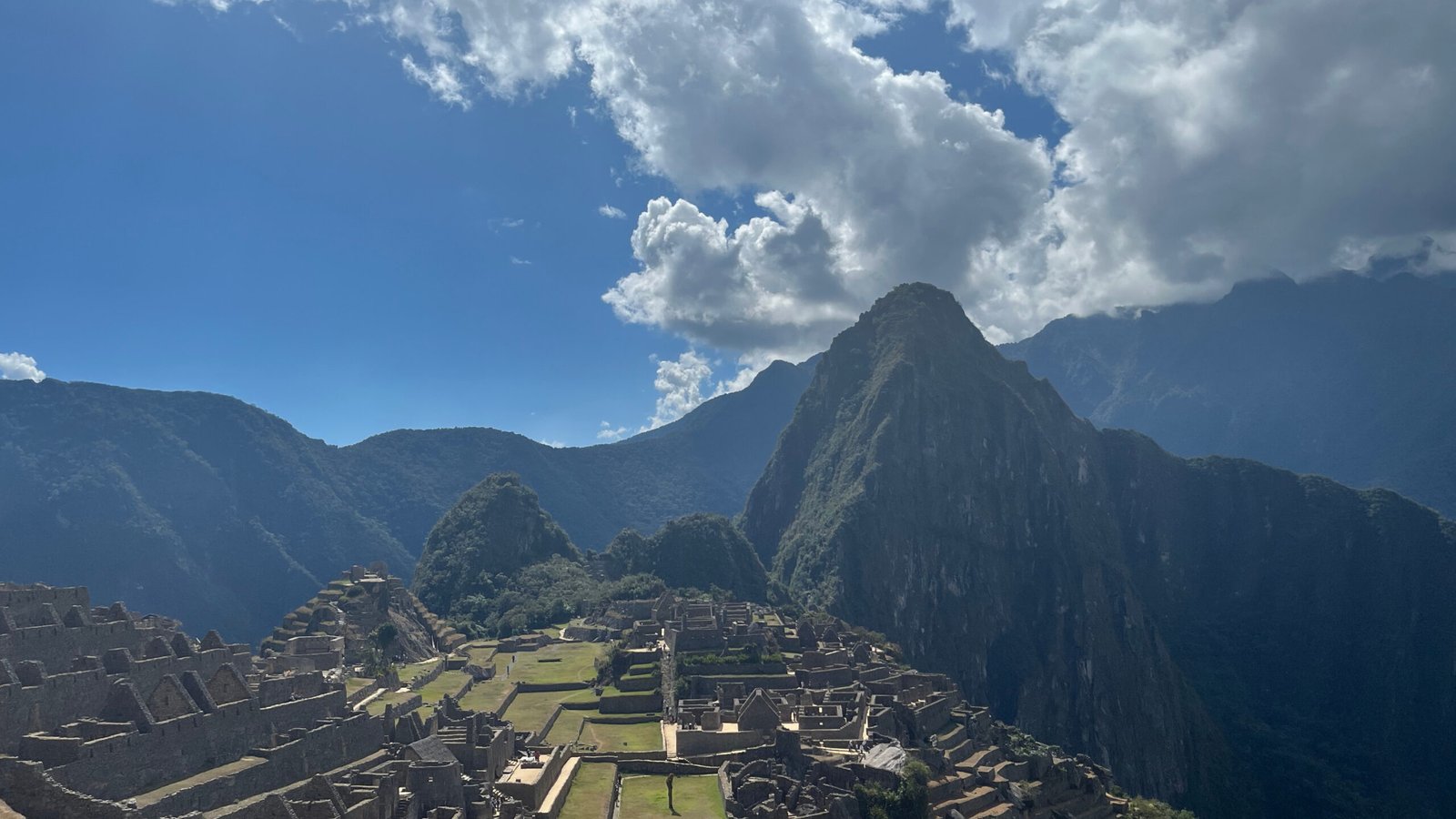
This summer, I spent a month living in Peru, visiting Machu Picchu and Cusco, and teaching English for two weeks in Lima.
I’m writing this retrospectively – so much has happened and my storytelling is likely to be quite nonlinear. But from notes, journal entries, photos and the odd ticket and leaflet that I’ve kept from my trip, I’m piecing together an account.
To begin with, where did the idea of travelling to Latin America come from? Anyone I’ve spoken to in person will know about my obsession with Bad Bunny, and so that’s really one of the main starting points. But beyond that, I’d researched a longer trip to South America last year after the announcement that I’d leave my role and it finally came about after changing direction a few times.
I already wanted to take a big trip to mark the year. I’d visited a few of my bucket-list places already: Athens, Istanbul, Marrakech. And I’d been to a few gigs in London over the summer, which I felt lucky to have been to.
Fortunately, I’d made a friend from the UK in Marrakech and we shared a lot of similarities. We met up a few times and the plan for a trip to South America just materialised as we chatted. We discovered we were both visiting Istanbul over Easter, so before our separate trips we made plans to reconvene and book up the flights to Peru.
What followed were a few months of anticipation, planning, visiting clinics for vaccines, packing lists, picking up gear for our trip, applying for ESTAs and combing through social media and blogs to research everything we could about the place. Machu Picchu – we’d finally see it!
A month or two after we’d booked up our flights, I was online one night. After returning from my teaching role where I’d run a session on career advice, I began researching some of the options I’d suggested to my students and found myself looking into English teaching placements abroad. Everything clicked into place: the location, the dates and the timings. I had a feeling this would be a good move, so I booked my place on a voluntary programme with IVHQ, changed my flights home and made plans to stay in Peru for a month.
Finally, after what felt like months of anticipation, we set off from Heathrow airport at the end of July.
Our journey was long: with a nine-hour flight from London, a five-hour stopover in Miami, followed by a four-hour flight to Lima and a six-hour time difference, it felt as if Saturday 25th July lasted for about 30 hours. After arriving in Miami, we navigated a not-too-welcoming airport, delays, exclusively Spanish-speaking customer service assistants and US border controls. Thankfully, we were together and made it through to the other side.
Miraflores, Lima
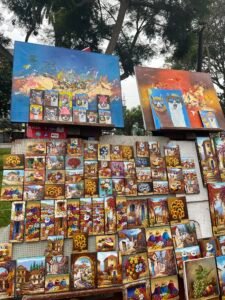
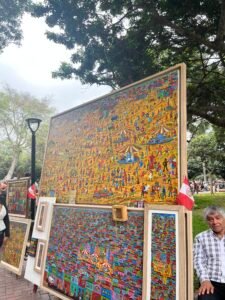
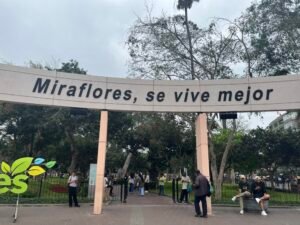
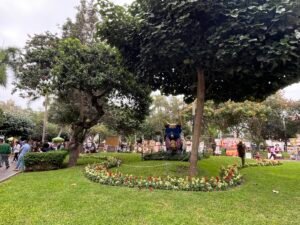
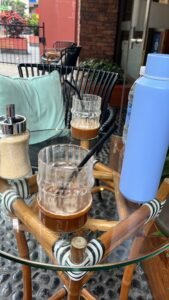
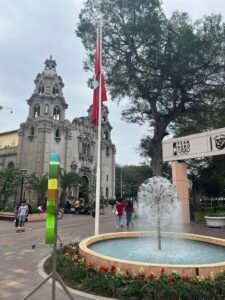
We arrived in the capital city of Peru at 4am, exhausted. Our transfer picked us up and brought us to our hotel, where we immediately slept. I was up for breakfast, went for a quick walk round the neighbourhood, and met up with my travelling buddy to go out for lunch. We had the very necessary coffee and brunch and walked round some local art installations in Kennedy Park in Miraflores, soaking up the Sunday vibe.
We wouldn’t meet the rest of our group until the evening, so we had plenty of time to explore the place, take in the neighbourhoods and enjoy being in a brand-new city. After a late-afternoon coffee, we also had a quick couple of hours to nap, met our group, then had a thankfully early night before heading out again the next morning.
Cusco
We flew out to Cusco on an early flight the next day. Arriving at Lima airport again so soon was fun with a new group of travellers. We met medics, nurses, families and people in various stages of life. The fun of travelling in a group is meeting people you’d never otherwise come into contact with, and your whole circle and worldview expands.
After the short domestic flight, we landed and headed straight towards our lodgings. We were warned about the effects of altitude and so at the hotel they offered us two types of tea: muña and coca. Muña tea was your standard mint tea; coca came from the same variety as cocaine leaves and the medics in our group were advised to be cautious about taking this ahead of any drug tests back at home. (Safe to say we opted for the muña tea).
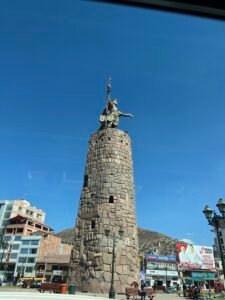
On our first day in Cusco, we passed the statue of Inca king Pachacuti in Cusco, for whom the estate of Machu Picchu was built. That afternoon, I visited the market with some of our group, and for starters we tried several Peruvian fruits that I’d never seen in the UK, including a Granadilla (Andean sweet passionfruit), Pitahaya (dragonfruit) and Tuna (or ‘prickly pear’, a fruit of the Indian fig cactus.)
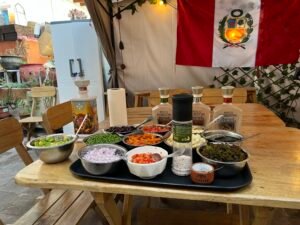
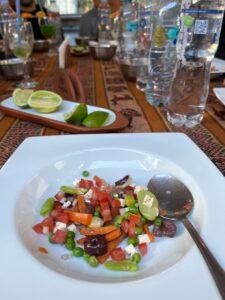
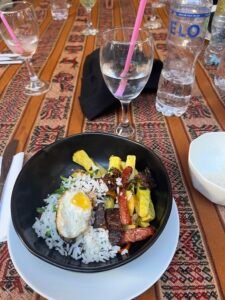
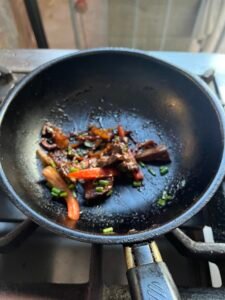
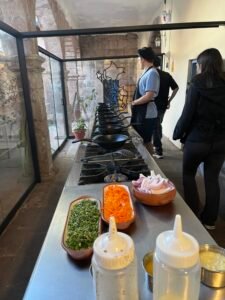
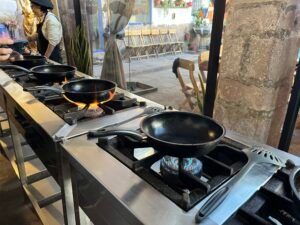
Afterwards, full up on exotic fruits and Peruvian dark chocolate, we attended a cooking class. Our host introduced us to some Peruvian dishes, including ensalata soltera, or ‘single salad’, a typical dish concocted by single people, before they get married and supposedly prepare more substantial meals. We also fried up a batch of lomo soltado, a succulent beef stir-fry dish that we cooked using red-hot cooking dishes. Being that close to the fire really brought our group closer together!
There were a few of us Brits; some ex-teachers from nearby in the UK; a couple my age from London with whom I had a fantastic conversation about life back home; the Americans in our group; and an American-Bulgarian who introduced me to a Punjabi rapper called Fakemink.
That evening I reconvened with my group and roommate; we discovered I’d left all my socks at home in the UK so went on a mission to buy some alpaca wool counterparts nearby, and had one of the coldest night’s sleep of our lives as the temperatures dipped in the high altitude.
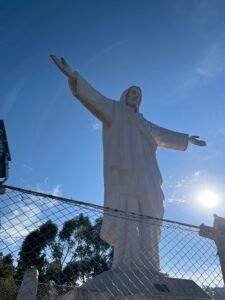
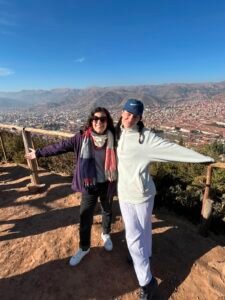
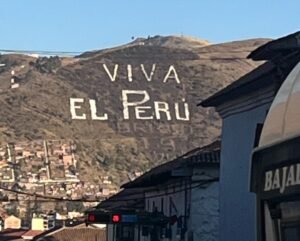
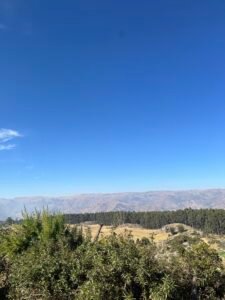
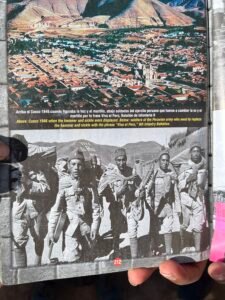
On a tour of Cusco the next morning, we visited the Cristo Blanco statue. Built in 1945, this 260-foot statue has a viewpoint over Cusco and the surrounding mountains. From a distance, we saw the iconic Viva el Peru slogan, etched into the Araway Qhata mountain. The history of this marking is fascinating and I recommend watching this video to fill you in. The slogan had been appropriated from the Communist symbol of a hammer and sickle in 1946, transformed into an oversized P for ‘Peru’.
The Communist and Peruvian Aprista parties had been competing for space on the mountain, with the Aprista party drawing its star on the side, only for the Communist party to replace it with their symbol. To resolve the situation, the Peruvian army sent in soldiers to write the phrase ‘Viva el Peru glorioso, BIM9, Cusco’. The BIM9 referred to the regiment in Cusco.
While only the phrase ‘Viva el Peru’ is visible now, it remains an important marker of the country’s history. You can see the image of our guide’s book below, which showed the Peruvian army and their campaign to change the slogan on the side of the mountain.
CCaccaccollo community, weaving workshop and pottery demonstration
Later that morning we headed to a weaving workshop in the CCaccaccollo community. Our kind hosts were incredibly hospitable, greeting us with hugs and applause as we disembarked from our bus. After we entered their colourful inner courtyard, decorated with woollen pom-poms and bunting to celebrate Peru’s Independence Day, we found out more about them.
The women living in this area were incredibly proud of their heritage, wearing colourful, traditional polleras (skirts) that they’d weaved by hand, chumpi (clasps to fasten clothing), lliclla (capes), jobona (jackets), and montera, the wide-brimmed hats. Traditionally only worn by women and worn at a certain angle, these could indicate a woman’s status as single, married or widowed.
Here, the women spoke Quechua (pronounced chee-cha), the indigenous language of Peru, as well as a little Spanish. There are important distinctions between Peruvian Spanish and Quechua, most notably that many of the common nouns and verbs have little to no overlap. Despite its source as an indigenous language, it remains widely spoken throughout Peru, and the many tour guides, local residents and taxi drivers we spoke to also used this language at home.
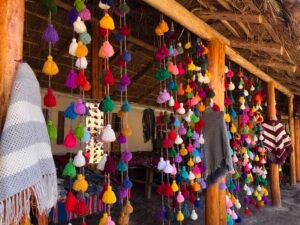
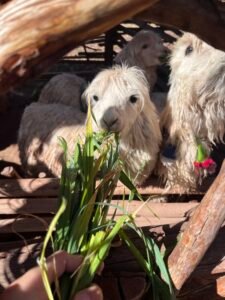
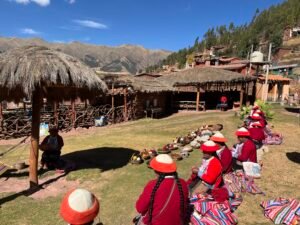
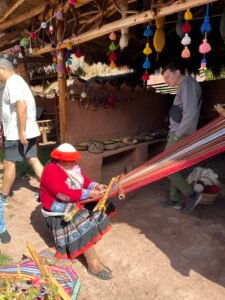
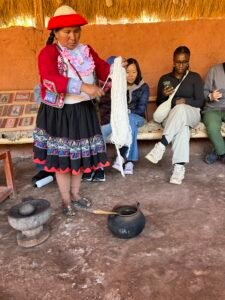
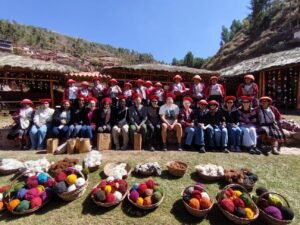
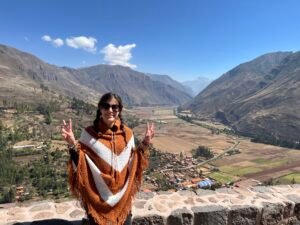
Once we’d settled in, our hosts allowed us to feed alpacas and llamas, take part in a workshop in which they weaved and dyed alpaca wool, and to browse their hand-made products (of course I emerged with an orange poncho, a knitted llama, a purse, gloves, and more bracelets than I can count.)
The women in this community were self-sufficient and this made the encounter even more special. It was fascinating to see how they used natural materials in their products and produced everything sustainably. What’s more, they passed down these vital skills to younger members of the community to ensure that it would be a durable practice and remain a sustainable business.
Pottery demonstration
After the enlightening weaving workshop, we headed up the road for a pottery demonstration and the best home-made empanadas of our lives. Here, women made clay bricks by hand (or foot), expertly kneading the materials and producing sturdy bricks in a matter of minutes. I’d image it’d have taken some of our group hours to achieve the same results. This was especially impressive and we couldn’t help but offer a round of applause once the clay was complete. Alongside the bricks, we also saw beautifully hand-made pieces of pottery, vases and trinkets, and again spent an inordinate amount of time buying little souvenirs here.
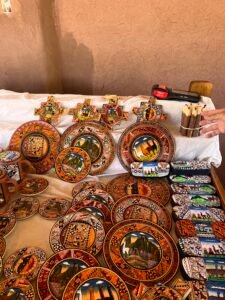
The bull, an important symbol in Cusco and Peru, kept popping up. In fact, I brought several of them along for the journey home. These little animal statuettes came in all sorts of vibrant colours and heralded back to traditional bull-fighting practices, although now they’re purely ornamental.
Sacred Valley
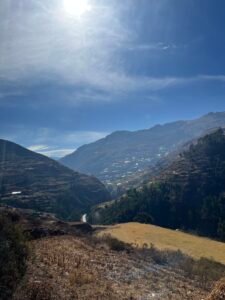
After a journey through some very narrow roads, we stopped for lunch at a beautiful venue. There we encountered magnificent scenery, and a building so light, spacious and airy, it felt like a wedding venue. With a dramatic backdrop of the Andes, it really felt like something in a dream. For me, that was the place that really made me feel as though I’d arrived in Latin America.
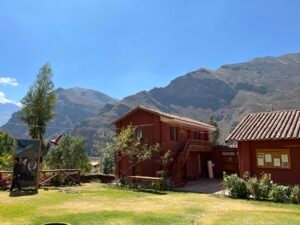
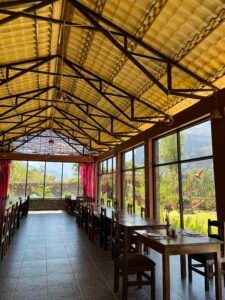
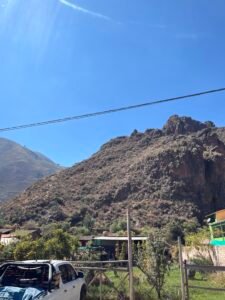
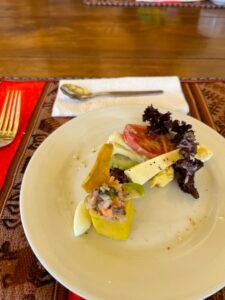
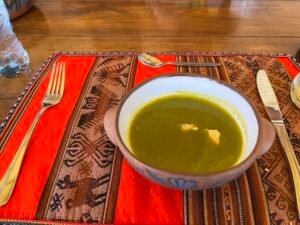
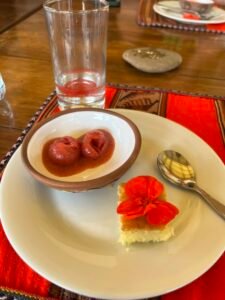
Our group had a wonderful lunch of several courses, including edible flowers and orange cake, and we enjoyed chatting and hearing each other’s stories. Tales from our American friend’s medical residency in Australia, our New York friend’s trip to visit her friend volunteering with the Peace Corps, and discussions about guinea pigs as a local delicacy ensued.
Despite the climbing temperatures and altitude, we enjoyed the afternoon. And after a perilous journey through lanes so narrow that our bus scraped against a police greyhound, we made it to our next stop, Ollantaytambo.
Ollantaytambo
Deep in the Andes, we encountered this small town that seemed preserved in time.
On an evening walk, we traipsed down small alleyways and through residential houses. In between homes hung colourful bunting, leftover from Independence Day in Peru, which Peruvians celebrated on 28th July, coinciding with our visit.
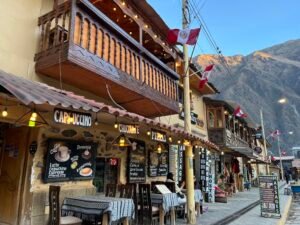
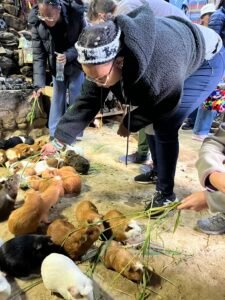
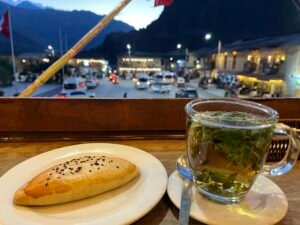
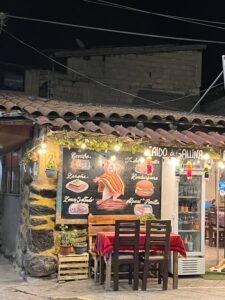
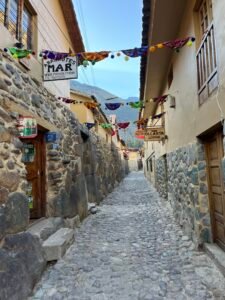
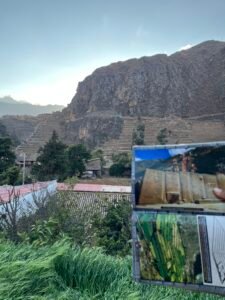
In Ollantaytambo, we also fed some guinea pigs (cuys), which were cute, but it was for a more nefarious purpose. Unfortunately, guinea pigs are a delicacy in Peru and we lost count of the number of restaurants we passed outside which we saw cardboard signs of huge, cartoon guinea pigs dressed in royal robes, beckoning us in. It didn’t feel quite right that they were on the menu.
Continuing our walk, from a distance we could see the famous Temple of the Sun in the mountains. As the sun set, we watched the changing shadows over the ruins.
That night, we stayed in a tiny lodge where we each had comfy beds in a little chalet. There was a beautiful courtyard full of native trees, which made it feel like a tropical country. Given our proximity to the Amazon jungle, we probably weren’t too far from a tropical climate.
Machu Picchu by train
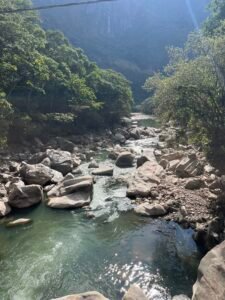
The next morning, we boarded the famous ‘Machu Picchu train’ from Ollantaytambo. Lugging our duffel bags and rucksacks down the road before 7am, jumping out of the way of waste collection lorries and tiptoeing over rivulets of water from the river flowing downstream, adjacent to the road, we make it to the platform.
Before we set off, we were greeted by Peruvian panpipes and music from a live band. The atmosphere was fun, if a little frenetic, as travellers from all over the world hastened to board. Street vendors called out to sell their wares, with colourful bunting again marking Independence Day, and there was a joyful atmosphere as people anticipated the journey.
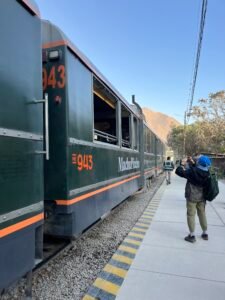
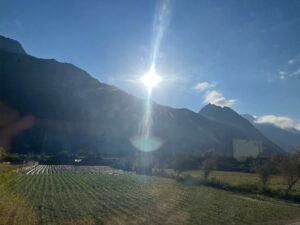
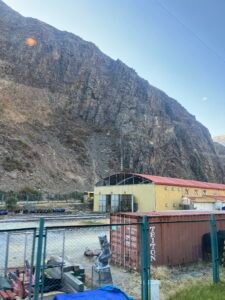
And, every so often, we’d hear the charming refrain over the loudspeaker: Peru Rail: creating once-in-a-lifetime journeys.
Aguas Calientes
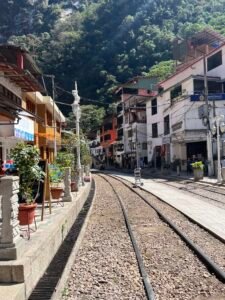
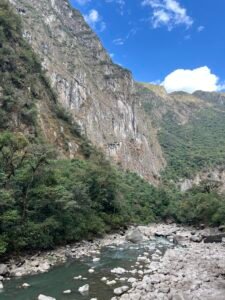
The journey took about two hours and we soon arrived in the small town of Aguas Calientes in the foothills of Machu Picchu.
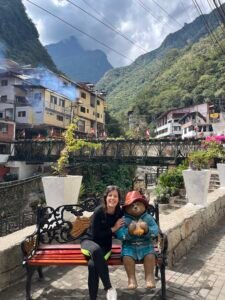
There we came across the town’s namesake, hot springs, plus an iconic statue of Paddington Bear (a huge deal for Brits) and plenty of charming restaurants and cafes on the railway line. To me, this was when I felt like we’d really arrived in the vicinity of Machu Picchu and the atmosphere was buzzing with expectant travellers, eager to see the sight we’d all come from round the world to witness.
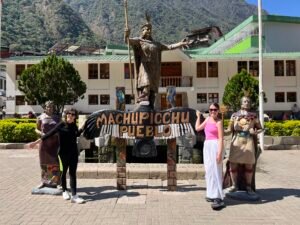
A few of us also took a walk for half an hour or so to visit the Machu Picchu museum. I’d highly recommend this little site to anyone passing through Aguas Calientes, as it filled in some important history of the sacred site, stories about the Inca Empire and accounts of archaeologists and academics such as Hiram Bingham who claimed to ‘rediscover’ the city.
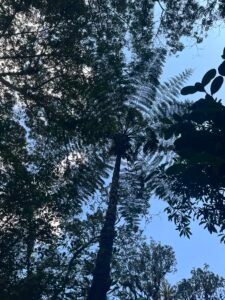
Nestled next to the museum was a tiny, understated botanical garden – so small you might’ve missed it were it not pointed out. This was an unexpectedly wonderful part of our trip, where we saw towering date palms, fire-orange orchids with hallucinogenic qualities and a whole array of tropical flowers. For anyone visiting Aguas Calientes, I’d urge you not to miss this hidden delight.
I will say that our hotel here was probably my least favourite of the trip and made us feel as though we’d inhaled some noxious substances in the night. However, we checked out as soon as we could the next morning to prepare for the big day we’d been waiting for.
Machu Picchu
It’s hard to put into words the experience of visiting Machu Picchu. Despite 19th-century Harvard professor Hiram Bingham claiming he was the first to discover it, this city has remained in the same spot for thousands of years. Uncovered in the 15th century, the Inca ruins are revelatory to see.
Evidence of sophisticated ancient irrigation and plumbing systems still remain and the maze of smaller alleys and archways demonstrates a system that connected the small city. It was truly amazing to see one of the ancient wonders of the world. Having also seen the ancient library at Ephesus, this felt to me like a pilgrimage into ancient worlds.
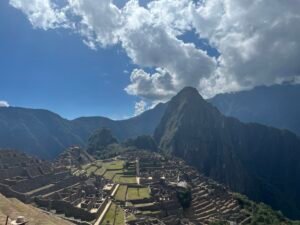
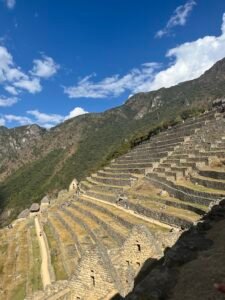
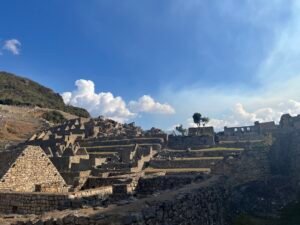
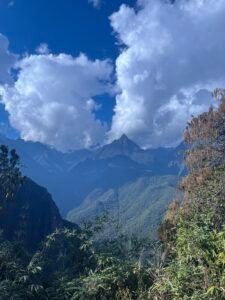
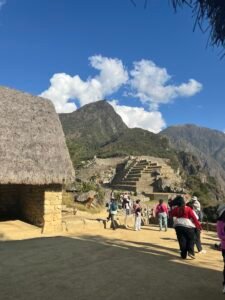
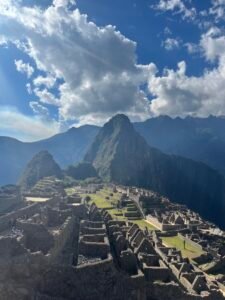
One of the biggest hiccups of our trip was that my friend and I were separated from the rest of the group for unexplained reasons, meaning that we pretty much encountered Machu Picchu as if we were solo travellers. Although it meant a day without our new friends, we received a private tour around the ancient city and got access to the views around Circuit 2 later in the afternoon, once the early-morning crowds had dispersed, so perhaps we had the best experience in the end.
After witnessing Machu Picchu, everything that followed felt quite surreal. One of my favourite memories from the trip was when my friend and I landed back in Ollantaytambo and had the most fun taxi journey of our whole trip to Peru. For two hours, we had a wonderful conversation in broken Spanish with a taxi driver who took us back to Cusco. He generously gave us free rein with the aux cable, letting us play Bad Bunny and Taylor Swift covers in Spanish.
We spoke about families, travelling, the UK, Peru, our schools and students, and the fact that I forgot to pack my socks. At one point in the journey, he pulled to a stop at the side of the road and motioned for us to get out. Pointing upwards, he showed us how clear the night was and that thousands of stars were visible. It really was such a beautiful and spontaneous moment of the trip and remains, for me, one of my favourite memories.
Rainbow Mountain
The only downside of rolling into Cusco, elated after such a wonderful day, was that we had to be up at 4am the next morning to get to Rainbow Mountain.
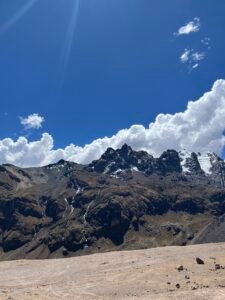
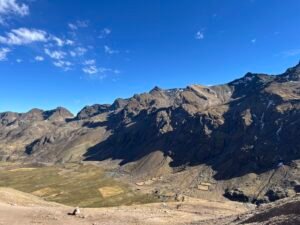
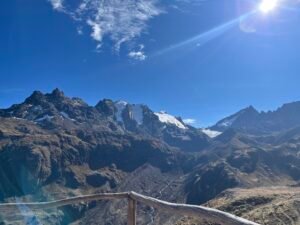
The Montaña de Colores is famous throughout Peru and it was one of the many sights we were most looking forward to seeing while we were there.
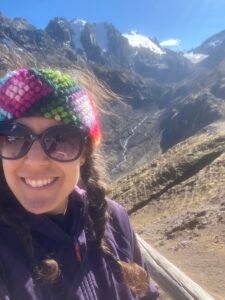
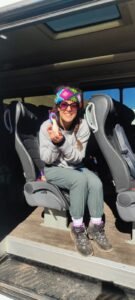
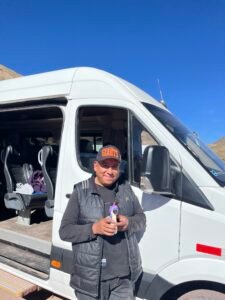
For me, the altitude was intense, but the scenery was unforgettable. Although the combination of the early start, winding rounds and altitude meant that I didn’t complete the hike, I had an excellent time with our bus driver, chatting with him for the morning in Spanish, sharing playlists, learning about his DJ career and even taking pictures with a tiny, knitted llama (llamita) I’d bought that week. So I think everything worked out as it was meant to.
Farewells and return to Lima
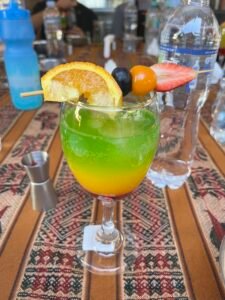
We had a farewell meal with the group that night, many of us tired from the 4am start but in awe of the sights we’d seen over the previous few days. My dinner of choice was a local risotto and we completed the evening with a cocktail-making class in Cusco, which some were brave enough to attempt now that we’d acclimatised to the attitude.
The following morning we were up slightly later for a lunchtime flight back to Lima, and waved goodbye to two of our group who were intrepid enough to venture into the Amazon, staying at a lodge there for the weekend.
On return, we felt as if we’d seen and experienced so much that we weren’t the same people who’d boarded the outbound flights, bleary-eyed, only that Monday morning. A few of us got some lunch back in the downtown Miraflores district, chatted about our experiences of the week and eventually said our goodbyes. I found it strange being back in the city we’d started in, having experienced so much.
It was then that I knew I had to reset before the next leg of my journey: teaching English. So much happened on that part of the trip that I’ll write it all up in another post. But suffice to say, once I’d done my laundry at the laundromat and met a few other travellers who were just starting their journey to Machu Picchu, standing in the same spot we had a week ago, I felt excited for them to experience everything we’d encountered for themselves.